
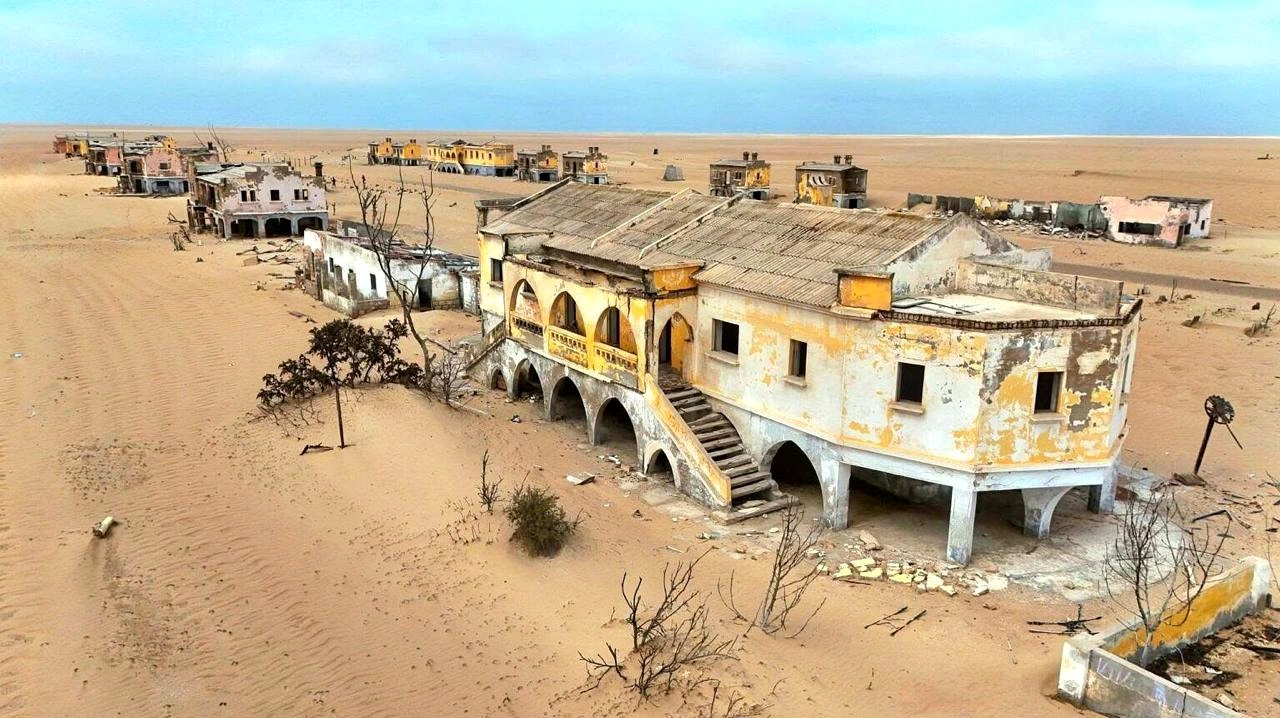
Abandoned buildings at Baía dos Tigres on Angola’s remote southern coast

ANGOLA · NAMIBE PROVINCE · GHOST TOWN

Baía dos Tigres: How the Peninsula Became an Island

A remote fishing settlement lost its land connection — and, with it, the freshwater lifeline that made permanent life possible.

São Martinho dos Tigres was once a working fishing settlement on a long sandy peninsula in southern Angola. Its history changed dramatically when the Atlantic cut through the narrow land connection.

14 March 1962

An Angolan published history of Baía dos Tigres records the breach on 14 March 1962. The ocean cut through the peninsula’s isthmus, turning the outer sand spit into what is now Ilha dos Tigres.

The settlement’s freshwater system depended on a pipeline running from the Cunene River area. When the land connection failed, that supply became a major problem. The same source describes a settlement of roughly 1,500 people with fishing and canning activity before final abandonment.

Fishing continued after the breach

The break did not empty the island instantly. Published accounts indicate that fishing activity continued into the 1970s, but the combination of isolation, water supply problems and Angola’s political upheaval eventually left the settlement abandoned.

Today the old buildings, church and industrial remains sit in an environment shaped constantly by wind, sand and ocean movement.

Why it belongs in our Angola stories.

Baía dos Tigres combines fishing history, geography and the same remote Atlantic landscape that defines the southern Angola expedition experience.

Explore Angola Expeditions

A DATE WORTH CHECKING

Why some sources say 1963.

Not every published source gives the same year. Modern Angolan references and multiple historical summaries give 14 March 1962, while one current U.S. nautical publication describes the sea breaking through in 1963.

When sources conflict, we prefer to show the discrepancy rather than quietly pick the version that makes the cleanest caption. For our own historical content, we use 14 March 1962 because it is supported by Angolan historical material and reporting that gives the exact date.

What survives

Published accounts describe the church, houses, fishing-industry buildings and cemetery as still visible, though increasingly affected by windblown sand and coastal change. The surrounding waters remain biologically rich and support large seabird and seal populations.

Sources used for this page include the Angolan publication Baía dos Tigres hosted by RCNA and Lusa/RTP reporting on the abandoned settlement. RCNA reference → · Lusa/RTP report →

ANGOLA STORIES

History makes the route more than kilometres.

See the other places behind our Angola expeditions.

More Stories
WhatsApp